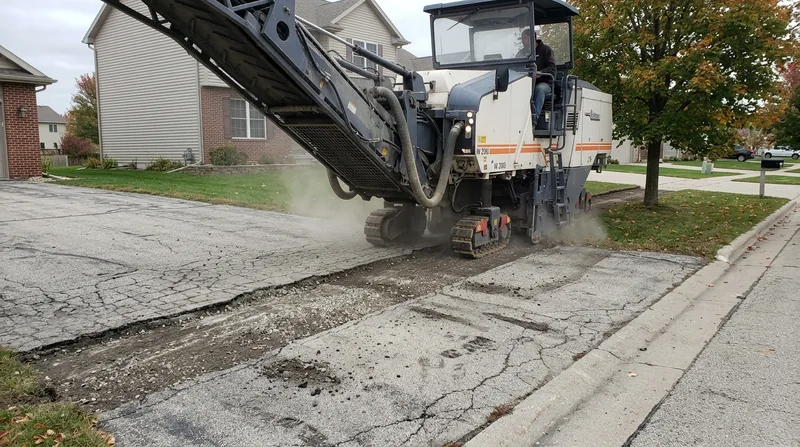




When asphalt milling and removal becomes necessary in Green Bay, it means the surface layer has failed beyond what a simple overlay can fix. The heavy freeze-thaw cycles and deep frost heave that define Northeast Wisconsin winters break asphalt down from the top, and alligator cracking spreads fast once it starts. Milling strips that damaged layer down to a base that can still carry the load, preparing the drive for a new wearing course or a full rebuild. We remove the failed material and haul it, leaving you with a stable platform and a clear path to repair. This service is the bridge between a patch-and-pray approach and a complete driveway replacement, and it saves money when the base is still sound.
Why Asphalt Milling Matters in Greater Green Bay and Brown County
Green Bay driveways fail in a predictable pattern. The post-war ranches and Cape Cods on the east and west sides, the newer subdivisions in Howard, De Pere, Suamico, and Bellevue, and the older Victorian homes in the Astor district all share the same enemy: the red lake clay soil underneath heaves with the deep frost, and the salt spray from winter road treatment accelerates the breakdown of the asphalt surface. When alligator cracking penetrates more than halfway through the top layer, patching becomes a waste of money because the cracks return within a season. Milling removes that compromised layer and restores a sound base, which is far cheaper than full-depth replacement and far more durable than another overlay on a broken surface.
- We mill away alligator cracking and surface deterioration that patching cannot fix.
- Milling exposes the base layer so we can assess whether it is still structurally sound.
- The removed material is recycled, reducing landfill waste and hauling cost.
- A milled surface accepts a new overlay or fresh asphalt at a lower total cost than full-depth replacement.
- Milling prevents water from penetrating cracks and destabilizing the base during freeze-thaw cycles.
In the spring, when driveways thaw and the damage from winter becomes visible, milling is often the smart move before summer paving season.
Local example: A 20-year-old driveway in Ashwaubenon with severe alligator cracking across 60% of the surface would cost $3,500 to $5,000 to mill and resurface, versus $6,000 to $8,500 for full-depth replacement. The milled base remains structurally sound, so the overlay holds.
For more detail on when repair, resurfacing, and replacement make sense, see our guide to asphalt resurfacing and overlay.
How Asphalt Milling Works: Our Process in Green Bay
Milling is a controlled operation that strips the top layer of asphalt to a specified depth, typically 1.5 to 3 inches, depending on how much damage we need to remove. We use a milling machine with a rotating drum that grinds the asphalt into a recyclable material, which is then collected and hauled away. The process is fast, precise, and leaves a clean base for the next phase of work. Once milling is complete, we assess the exposed base layer for structural integrity, make any necessary repairs to that base, and then prepare the surface for new asphalt or an overlay.
- We measure the driveway and identify the depth of cracking to determine the milling depth.
- Our milling equipment grinds the damaged asphalt layer into recyclable millings.
- We remove all milled material and haul it to a licensed recycling facility.
- We inspect the base layer for soft spots, ruts, or erosion that need repair before overlay.
- We profile the milled surface and prepare it for new asphalt or a seal coat.
- We coordinate timing so the new wearing course is applied as soon as weather permits.
The entire milling operation typically takes one day for a residential driveway, and the material is removed the same day.
Real example: A 2,500-square-foot driveway in Green Bay with alligator cracking to a depth of 2 inches is milled to remove that layer, exposing a base layer that is still sound. We haul the millings, inspect the base, and the homeowner has the choice to resurface with a 2-inch overlay or mill and replace the full depth. The milled surface cost is 40% less than full replacement.
For information on the next step after milling, see our page on driveway replacement and how it compares to resurfacing.
Milling Approaches and When Each Works Best
The choice of milling depth and what happens after depends on the extent of the damage and the condition of the base. A shallow mill removes surface cracking and prepares for an overlay. A deeper mill removes alligator cracking that has penetrated the full wearing course. Full-depth reclamation goes all the way through and recycles the entire old asphalt, stabilizing it in place, which is useful for private roads and parking lots where complete removal is not practical. Each approach has a cost and a result, and we choose based on what the drive actually needs.
| Approach | Description | Best for |
|---|---|---|
| Shallow Mill (1 to 1.5 inches) | Removes surface wear and minor cracking, exposes a sound base for overlay. | Driveways with surface distress but no deep alligator cracking, preparing for a 2-inch overlay. |
| Standard Mill (1.5 to 2.5 inches) | Removes alligator cracking that has penetrated the wearing course, restores a stable base layer. | Residential driveways with moderate to severe cracking, most common in Green Bay after 15-20 years. |
| Deep Mill (2.5 to 3.5 inches) | Removes extensive cracking and soft or weakened base material, prepares for full-depth replacement. | Driveways with base layer damage or settling, where overlay alone will not hold. |
| Full-Depth Reclamation (FDR) | Grinds the entire asphalt section in place, stabilizes it with emulsion, compacts and reuses as a new base. | Private roads, parking lots, and rural driveways where removal is not practical or cost-effective. |
Each method is priced and timed differently, so a site visit is essential to determine which approach makes sense for your drive.
Asphalt Milling and Removal Cost in Green Bay: What to Expect
The cost of milling depends on the area to be milled, the depth of cracking, the accessibility of the drive, and what happens to the milled material. A typical residential driveway in Green Bay, De Pere, or Howard runs from $1,500 to $3,500 for milling alone, depending on whether you are milling a 2,000-square-foot drive or a 4,000-square-foot parking lot. The largest cost driver is the total square footage, followed by the depth of milling required. Removing and hauling the material is included in our estimate. If the base layer needs repair after milling, that is an additional cost quoted separately after inspection.
A few factors move the price up or down. A driveway with a steep slope or limited access for the milling truck may require extra setup time. A drive with soft or eroded base material will need more work after milling. A parking lot or private road with a large area will have a lower per-square-foot cost than a small residential drive. Getting written estimates from two or three contractors is the best way to compare, because each contractor may recommend a different milling depth based on their assessment of the damage and the base condition.
Cost example: A 2,500-square-foot driveway in Bellevue with alligator cracking to 2 inches depth would cost approximately $1,800 to $2,400 to mill, haul, and prepare the base for overlay. A 4,000-square-foot parking lot in Green Bay with similar damage would cost $2,500 to $3,800. Full-depth replacement of either surface would run 50 to 75 percent higher.
We provide written estimates that include the square footage, the milling depth, the tonnage of material to be removed, and the cost. For detailed pricing on milling and related services, visit our pricing page. Call us at (920) 536-4534 for a free estimate with no obligation.
Asphalt Milling and Removal Near Me: What Green Bay Homeowners Should Know Before Hiring
Milling is skilled work, and the quality of the milling and the assessment of the base layer directly affect how long the new asphalt will last. When you are looking for a contractor near Green Bay, De Pere, Ashwaubenon, or anywhere in Brown County, ask for references from recent milling projects, get a written estimate that specifies the milling depth and tonnage, and verify that the contractor is fully insured. Some municipalities in the Green Bay area require a permit if the milling work includes changes to drainage or involves the apron at the street line, so check with your local building department or HOA before you begin. If your property is in a master-planned community, your HOA may have rules about driveway materials and the timeline for completion, so verify those requirements upfront.
- Ask for a written estimate that lists the square footage, milling depth in inches, and tonnage of material to be removed.
- Request references from three or more residential or commercial milling projects completed in the last two years.
- Verify that the contractor is fully insured and ask to see a certificate of insurance covering liability and equipment.
- Check with your city or village building department to learn whether a permit is required for milling on your property.
- If you live in an HOA community, confirm any architectural or material standards that apply to driveway work.
- Confirm the timeline for milling and what happens next (overlay, full replacement, or base repair) so you understand the complete job.
A reputable contractor will be happy to answer these questions and will provide a clear, written scope of work before any equipment arrives on your property.
Ready to move forward? Contact us for a free, no-obligation estimate. We serve Green Bay, De Pere, Ashwaubenon, Howard, Bellevue, Suamico, Ledgeview, and surrounding areas in Brown and Kewaunee counties.
Asphalt Milling & Removal in Green Bay: Pricing Guide
| Service | Price | Details |
|---|---|---|
| Residential Driveway Milling | Starting at $1,500 | Standard mill depth 1.5 to 2.5 inches, includes material removal and haul to recycling facility |
| Parking Lot or Large Driveway Milling | Starting at $2,200 | 3,000 to 5,000 square feet, depth determined by cracking severity and base condition assessment |
| Deep Mill or Full-Depth Reclamation | On estimate | Milling beyond 2.5 inches or FDR work requires site inspection to assess base layer stability and material volume |
| Base Layer Repair After Milling | On estimate | Soft spots, ruts, or erosion in base discovered during milling are priced separately after visual inspection |
| Material Haul and Recycling | Included | Removal and transport of milled asphalt to licensed recycling facility with no separate charge to homeowner |
| Free Estimate | Free | Written estimate with tonnage and depth specifications, response within 24 hours at (920) 536-4534 |
Indicative pricing, the exact cost depends on square footage, finish, and site access. Free personalized estimate within 24h at (920) 536-4534.


