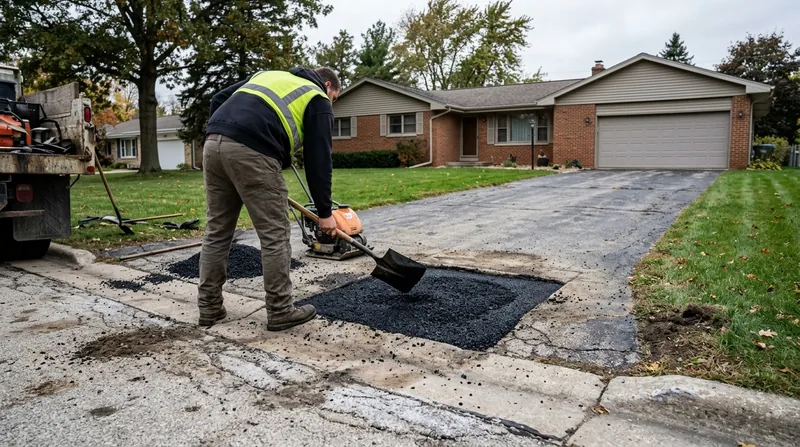




Pothole Repair & Asphalt Patching in Green Bay means the difference between a driveway that lasts and one that fails in sections every spring. Snowplow blades and repeated freeze-thaw cycles punch holes into the asphalt and concrete aprons on residential streets from the Astor historic district to the newer subdivisions in Howard and Suamico. We square the edges, tack the joint with bituminous adhesive, and compact full-depth patches before the hole widens and cold patch becomes your only option. Green Bay's heavy red lake clay soil heaves with deep frost, and the salt-stained curbs and plowed snowbanks of winter leave potholes that grow wider every time a car crosses them. Patching stops that spiral, but only if the base is solid and the patch is compacted to density. We measure tonnage on every job and give you the specification so you know what you are buying.
Why Pothole Repair Matters in Green Bay: The Freeze-Thaw Reality
Green Bay winters do not just create potholes, they weaponize them. The freeze-thaw cycle that dominates Northeast Wisconsin from November through April forces water into the smallest cracks in asphalt. That water expands as it freezes, lifting the surface and breaking the bond between the asphalt and the base. When the thaw comes, the pavement collapses into the void below, and a small crack becomes a pothole that swallows a tire. Snowplow blades accelerate the damage by striking the weakened edges and dragging chunks of asphalt out onto the street. By late March and early April, driveways on the east and west sides of Green Bay, in Allouez, Ashwaubenon, and Preble, show the damage: dark patches where the asphalt has fallen away, and standing water in the low spots where the base has settled.
- We remove loose and failed asphalt from the perimeter of the pothole and square the edges so the patch bonds to solid material.
- We tack the joint with hot bituminous adhesive to create a waterproof seal between the old asphalt and the new patch.
- We compact the patch to the same density as the surrounding pavement so it does not settle or ravel under traffic.
- We provide tonnage and specification on every patch so you own the record of what was done.
The goal is to stop the leak, not just fill the hole. A patch that sits proud of the surface or that is loose at the edges will fail again inside of one season.
Key info: A single pothole on a driveway in Green Bay is often a sign of a larger problem below the surface. If the base has failed over a wide area, patching individual holes throws money away. We assess whether your driveway needs patching, resurfacing, or replacement, and we tell you which one makes sense for your budget and the age of the pavement.
For more context on driveway repair options across the lifespan of asphalt, see our Driveway Repair page.
How We Patch Potholes in Green Bay: The Step-by-Step Process
Pothole repair is not a five-minute job, and the difference between a patch that holds and one that fails in a year comes down to preparation and compaction. We treat every pothole as a full-depth patch: we remove all failed material, we inspect the base, we tack the joint, we compact the new asphalt in lifts, and we finish flush with the surrounding surface. The process takes time because asphalt must be placed at temperature and compacted while hot to achieve the density that makes it durable. A cold patch or a hand-tamped patch will ravel and settle and fail.
- We measure the pothole and mark the square cut line so we remove all failed material and create a clean edge for the patch to bond to.
- We excavate to the base and inspect the subgrade for soft spots, water, or erosion that would compromise the new patch.
- We scarify the edges of the hole so the new asphalt bonds mechanically, not just mechanically, to the existing pavement.
- We apply hot bituminous tack coat to the edges and the base so the patch creates a waterproof seal and does not separate under traffic.
- We place and compact the new asphalt in two or three lifts, depending on the depth of the hole, so we achieve full density throughout the patch.
- We finish the patch level with the surrounding surface so water does not pond on the repair and begin the freeze-thaw cycle again.
A proper patch holds because it is compacted to the same density as the original pavement and because the joint is sealed against water infiltration.
Local example: A driveway on the east side of Green Bay near the old neighborhoods shows three potholes in the apron and one in the main drive. The apron potholes are the result of salt and freeze-thaw damage to the concrete and asphalt transition. The main drive pothole is the result of base failure under traffic. We patch all four, but we also explain that the apron may need replacement if the damage spreads, and we flag that the main drive may be approaching the point where resurfacing makes more economic sense than continued patching.
For details on when to resurface instead of patch, see our Asphalt Resurfacing & Overlay page.
Patching Methods and Materials
| Approach | Description | Best for |
|---|---|---|
| Full-Depth Patch | We remove all failed asphalt and base material, inspect the subgrade, tack the joint, and compact new asphalt in lifts to full density. | Potholes, edge breaks, and localized base failure on driveways and parking lots with solid subgrade. |
| Spray-Injection Patch | We inject hot bitumen and aggregate into the pothole from the sides, then compact the repair. Faster than full-depth on shallow holes in good base. | Small to medium potholes on residential driveways where the base is not compromised and the hole is less than 4 inches deep. |
| Mill-and-Fill Patch | We mill the surface around the pothole to create a uniform depth, then fill with new asphalt and compact flush with the surrounding pavement. | Multiple potholes in the same area or potholes adjacent to uneven pavement where leveling improves drainage and appearance. |
| Temporary Cold Patch | We use ready-mix cold asphalt as a temporary repair when winter prevents hot-mix placement or when a permanent repair must wait for warmer weather. | Emergency pothole filling in late fall or early spring when hot asphalt cannot be properly compacted, with the understanding that a permanent patch will follow. |
The method we recommend depends on the size and location of the pothole, the condition of the base, and the time of year. We explain the trade-off between cost and durability so you can make an informed choice.
Pothole Repair & Asphalt Patching Cost in Green Bay: What to Expect
Pothole repair in Green Bay starts at $450 for a single full-depth patch on a residential driveway. That price covers the excavation, base inspection, tack coat, and compaction of the new asphalt to specification. The final cost depends on the size of the pothole, the depth of the excavation, the condition of the base, and the distance from our yard. A pothole that is 2 feet by 3 feet and 6 inches deep costs less than one that is 4 feet by 6 feet and 12 inches deep. A patch on a driveway in Green Bay costs less than one in a rural area in Kewaunee County because of travel distance. Multiple potholes on the same driveway are priced per patch, but we often find that extensive potholing signals a larger problem with the base or drainage, and we recommend resurfacing or replacement instead of patching each hole individually.
We provide written estimates with the tonnage and depth of the patch so you can compare our work to other quotes. We do not charge for the estimate, and we respond within 24 hours at (920) 536-4534. If your driveway has more than three or four potholes, or if the holes are spread across more than 30 percent of the surface, the cost of repeated patching often exceeds the cost of a full resurfacing or mill-and-overlay. We will tell you that plainly so you do not throw money at a dying driveway.
For a detailed breakdown of all our pricing across services and locations, see our Pricing page.
Pothole Repair & Asphalt Patching Near Me: What to Look for When Hiring a Contractor in Green Bay
The asphalt paving trade in Wisconsin has no state license, but most municipalities in the Fox Valley and Green Bay area do license and bond asphalt contractors. Verify with your city or village whether a license is required for driveway work in your jurisdiction, and ask any contractor you call whether they hold the local credentials your municipality requires. A legitimate contractor will give you a written estimate with tonnage and depth specifications, will explain the method and timeline, and will provide references from recent work in Green Bay or a nearby community. Watch for red flags: unsolicited door-to-door offers, a price that seems too low, no written contract, a request for a large cash deposit before work begins, or out-of-state plates on the trucks.
- Ask for a written estimate that includes the size of the pothole, the depth of the excavation, the tonnage of asphalt, and the compaction method.
- Verify that the contractor is fully insured and can provide a certificate of insurance for your records.
- Check references from homeowners or property managers in Green Bay or De Pere who have had pothole repair or patching work done in the past two years.
- Confirm that the contractor understands local permitting rules if the pothole is near the curb, the sidewalk, or the public right-of-way, or if the repair involves drainage changes.
- Ask whether the patch comes with a workmanship warranty and for how long, and get that promise in writing.
We are fully insured, we provide written estimates with tonnage and specifications, and we respond to calls within 24 hours. We have been in business since 2016 and we work throughout Green Bay, De Pere, Ashwaubenon, Howard, Bellevue, Suamico, and the surrounding communities. If you want to verify our local standing or ask for references, call us at (920) 536-4534 or visit our contact page to request a free estimate.
Pothole Repair & Asphalt Patching in Green Bay: Pricing Guide
| Service | Price | Details |
|---|---|---|
| Single pothole patch (full-depth, under 4 sq ft) | Starting at $450 | Excavation, base inspection, tack coat, compaction to specification, finished flush with surface |
| Medium pothole patch (4 to 9 sq ft) | Starting at $750 | Larger excavation and deeper base work, multiple compaction lifts, tack coat on all edges and base |
| Large or deep pothole patch (over 9 sq ft or over 8 inches deep) | Starting at $1,200 | Extensive excavation, full base assessment, possible subgrade repair, multiple asphalt lifts, compaction to density |
| Multiple potholes on same driveway (three or more) | On estimate | We assess whether patching or full resurfacing is more cost-effective and recommend the option that saves you money long-term |
| Travel | Included | No separate charge for service calls in Green Bay and surrounding Brown and Kewaunee County communities |
| Free estimate | No charge | Written estimate with tonnage and depth specification provided within 24 hours of your call to (920) 536-4534 |
Indicative pricing, the exact cost depends on square footage, finish, and site access. Free personalized estimate within 24h at (920) 536-4534.


