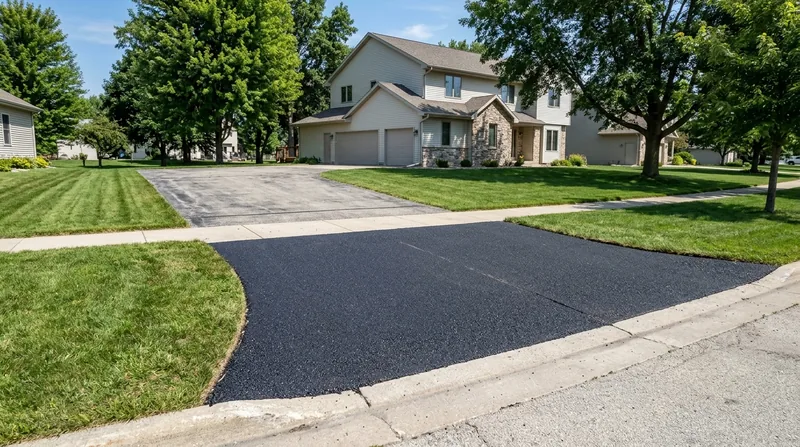




Driveway extensions, widening and aprons in Green Bay take the worst beating of any part of your drive. The frost heave that lifts pavement three inches in January, the plow blade that catches the edge at the street line, the salt spray that accelerates deterioration, the heavy red lake clay soil that holds water and forces ice underneath, the shaded sections where melt refreezes nightly, all of it hits hardest where your driveway meets the public right-of-way. Whether you have a narrow 1920s bungalow drive on the east side running back to a detached garage, a post-war Cape Cod in Allouez with a single-pitch blacktop apron, or a newer three-car suburban driveway in Howard or De Pere, that transition zone fails first and fastest. We rebuild or widen that section and tie new hot mix flush into your existing drive, restoring proper drainage and eliminating the lip that catches plows and collects water.
Why Aprons and Driveway Extensions Fail Fast in Green Bay
The apron is where your driveway meets the street, and in Green Bay's climate it is the collision point of three destructive forces: deep frost heave from the clay soil and winter freeze-thaw cycles, plow blade impact from seasonal snow removal, and water pooling from inadequate slope or base failure. The result is cracking, settlement, spalling, and eventually a sunken or raised lip that catches wheels and traps melt. A wider apron also improves sight lines at the street, reduces splash and spray onto sidewalks and adjacent properties, and makes snow removal easier for both your equipment and the city plow.
- Frost heave lifts the apron unevenly because the base lacks proper compaction or the subgrade drains poorly into clay.
- Plow blades catch raised or cracked edges and break chunks free, widening the damage year to year.
- Water pools on a low apron and percolates into the base, weakening it further and accelerating failure.
- Widening the apron improves drainage slope, increases the working surface for plowing, and reduces the stress concentration at the street line.
- An apron extension also creates usable width for parking, turning, or landscaping without requiring a full driveway replacement.
Extending or rebuilding the apron is one of the fastest and most cost-effective ways to arrest this cycle and add functional width to a narrow drive.
Green Bay example: A 1920s bungalow in the Astor historic district on the east side has a 9-foot-wide drive running back 50 feet to a detached garage. The apron at the street is cracked and settled 2 inches below the street grade. We extend the apron 6 feet wider and 4 feet deeper into the yard, tie it to the existing drive with a mill-and-overlay transition, and reset the drainage slope to shed water. The homeowner gains turning room and eliminates the lip that catches the city plow every winter.
For guidance on permit requirements for apron work in your municipality, contact your local building department or village engineer. Driveway repair often begins with an apron assessment, because that zone tells us whether the entire drive is sound or whether resurfacing or replacement is the better path forward.
How We Build Driveway Extensions and Aprons in Green Bay
A driveway extension or apron rebuild starts with excavation and base work. We remove the failed section or extend into the yard, prepare the subgrade, lay a compacted crushed-stone base (usually 4 to 6 inches depending on soil and intended use), and then lay hot-mix asphalt in lifts. The key is proper compaction and correct drainage slope so water sheds away from the driveway and foundation. We tie the new work to your existing drive seamlessly, either by milling the edge of the old surface to create a flush joint or by feathering the new mix into the old. The job takes one to three days depending on size and weather, and your drive is ready to use once the asphalt cools.
- We verify utility locates through Wisconsin 811 before any excavation, because apron work can disturb gas, electric, water, or sewer lines near the street.
- We remove the failed apron or existing section to the depth needed to reach stable subgrade, usually 8 to 12 inches.
- We grade and compact the subgrade, then lay crushed-stone base and compact it in 2-inch lifts to proper density.
- We heat and lay hot-mix asphalt in two or more lifts, compacting each layer, and finish with a smooth wearing course.
- We mill the edge of your existing driveway and tie the new asphalt to it, creating a flush, seamless joint with no lip or ridge.
- We establish proper drainage slope (typically 2 to 3 percent) so water runs off rather than pooling.
The entire process is straightforward and leaves your driveway stronger and wider at the point of greatest stress.
Ashwaubenon example: A brick ranch built in 1955 sits on a single-pitch blacktop drive in a post-war neighborhood. The apron has settled and cracked from frost heave, and the homeowner wants to widen it for a second parking space. We excavate the old apron, set utilities with 811, prepare a 5-inch stone base, and lay 3 inches of hot-mix asphalt. We mill the existing drive edge and tie it seamlessly. The new apron is 14 feet wide and 16 feet deep, properly sloped, and ready for two vehicles side by side.
For more on the repair-versus-replace decision, see our page on asphalt resurfacing and overlay, which often precedes an apron extension if the main drive is still sound.
Driveway Extensions, Widening and Aprons: Methods and Approaches
Apron work comes in several forms depending on your site and your goal. Some homeowners need only the failed apron rebuilt to its original size; others want to widen for parking or sight lines. Some yards have room to extend backward; others are constrained by property lines or utilities. We assess the site, recommend the best approach, and provide a written estimate with tonnage and thickness specs.
| Approach | Description | Best For |
|---|---|---|
| Apron Replacement | Remove the failed apron from the street line back 4 to 8 feet, excavate to stable subgrade, set new base and asphalt, and mill and tie to the existing drive. | Frost heave, settlement, or cracking at the apron; the rest of the driveway is sound. |
| Apron Widening | Extend the apron laterally (left or right) to gain width without extending into the yard, or extend forward to the street line if the current apron is too short. | Narrow driveways on historic or post-war lots; adding parking or turning room without a full-drive rebuild. |
| Apron Extension | Extend the apron backward into the yard 4 to 12 feet to create additional parking, maneuvering room, or a transition zone between the street and the main drive. | Lots where the current apron is too short; improving drainage and sight lines; adding functional width to a narrow drive. |
| Apron with Turnaround | Extend and widen the apron to create a T-shaped or L-shaped turnaround, allowing vehicles to turn without backing onto the street. | Long, narrow drives; improving safety and convenience; dead-end or cul-de-sac lots. |
Each approach is priced on site based on the size of the new surface, the depth of excavation, the condition of the subgrade, and local permit requirements. We provide a written estimate with tonnage and thickness so you know exactly what you are paying for.
Driveway Extensions, Widening and Aprons Cost in Green Bay: What to Expect
An apron replacement or extension typically runs from $1,800 to $4,500 depending on the size of the new surface, the depth of excavation, soil conditions, and whether the work touches the public right-of-way and requires a permit. A small apron rebuild (12 feet wide by 6 feet deep, roughly 72 square feet) might start near $1,800 to $2,200. A larger extension (16 feet wide by 12 feet deep, roughly 192 square feet) with deeper excavation and base work could run $3,500 to $4,500. Widening an existing apron by 4 to 6 feet across its length adds area and cost but saves on excavation depth compared to a full rebuild.
The main cost drivers are:
- Size of the new apron or extension in square feet.
- Depth of excavation needed to reach stable subgrade in clay or fill soil.
- Base preparation and compaction, including stone tonnage and labor.
- Hot-mix asphalt tonnage and thickness (usually 3 to 4 inches of wearing course).
- Milling and tying into the existing drive, which adds labor but eliminates a lip or ridge.
- Utility locates and any permitting required by your municipality.
Get two or three written estimates from local contractors. Each should specify the square footage, the depth and type of base, the tonnage of asphalt, the thickness of each lift, and the final price. Avoid any estimate that is vague about tonnage or thickness, or that quotes a per-square-foot price without seeing the site. For more detail on pricing factors, visit our full pricing page.
What to Look for When Hiring an Asphalt Paving Contractor Near Green Bay
Choosing the right contractor for apron work means checking their local standing, understanding their process, and verifying that they know the permit and drainage rules in your municipality. Licensing and permitting rules for asphalt paving vary by village and city across Greater Green Bay. Some municipalities require a permit for any work that touches the apron, the curb, or the public right-of-way; others do not. If your property is in an HOA or a master-planned community, architectural standards may govern the material, color, and extent of the apron. Your contractor should be familiar with these rules and help you navigate them before work begins.
- Verify that the contractor is fully insured and ask to see a current certificate of insurance.
- Ask for references from recent apron or driveway work in Green Bay, De Pere, Ashwaubenon, or Howard.
- Request a written estimate that specifies the square footage, base depth and type, asphalt tonnage, thickness, and final price.
- Confirm that the contractor will call Wisconsin 811 for utility locates before any excavation begins.
- Ask whether the contractor will help you verify permit requirements with your village or city building department.
- Avoid any contractor offering a verbal estimate, a handshake agreement, or a price that seems too good to be true.
- Check whether the contractor is local and has a verifiable address and phone number in the Green Bay area.
We have been in the Green Bay area since 2016, and we maintain a local address and local plates. We provide written estimates with tonnage and thickness specs, we pull utility locates, and we help homeowners navigate local permitting. For a free, no-obligation estimate on apron work, call us at (920) 536-4534 or visit our contact page to request an appointment.
Driveway Extensions, Widening & Aprons in Green Bay: Pricing Guide
| Service | Price | Details |
|---|---|---|
| Small apron rebuild | Starting at $1,800 | 12 feet wide by 6 feet deep apron, crushed-stone base, 3-inch asphalt, milled tie-in to existing drive |
| Medium apron extension | Starting at $2,800 | 16 feet wide by 10 feet deep extension, 5-inch base, 3-inch asphalt, includes utility locate and drainage slope |
| Large apron or turnaround | Starting at $4,200 | 20-plus feet wide, 12-plus feet deep, complex shape or utilities, requires site visit and detailed estimate |
| Apron widening only | Starting at $2,200 | Extending existing apron laterally 4 to 6 feet, less excavation, milled tie-in, based on linear footage and width |
| Utility locates and permits | Included | Wisconsin 811 call and permit navigation included in estimate; no separate fee |
| Free estimate | No obligation | Response within 24 hours, site visit, written spec with tonnage and thickness, no charge to request |
Indicative pricing, the exact cost depends on square footage, finish, and site access. Free personalized estimate within 24h at (920) 536-4534.


