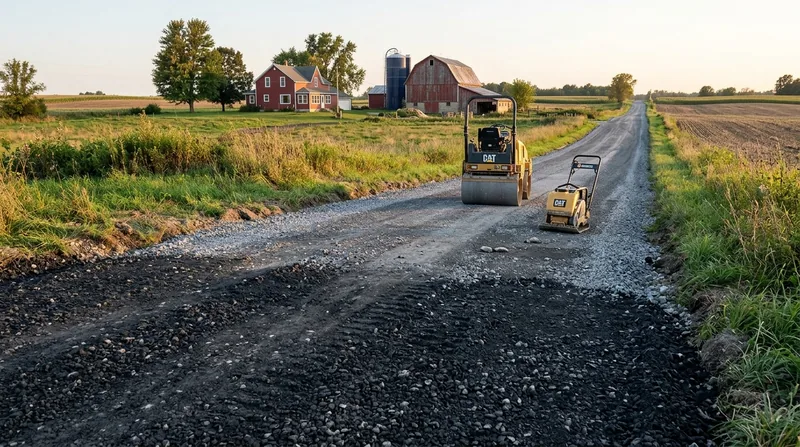




Gravel driveways across Green Bay and Brown County take a beating every spring. The heavy red lake clay beneath them holds water like a sponge, and winter plow traffic churns the surface into ruts and washboard. A gravel driveway installation and grading job here is not just about spreading new stone; it is about reshaping the crown, pitching the surface to shed water instead of pooling it, and compacting a base that will hold through the next freeze-thaw cycle. From the long lanes running back through dairy farms in Kewaukauna and Denmark to the modest residential driveways in the neighborhoods around Lambeau Field, gravel is still the most common surface in Greater Green Bay, and it demands seasonal maintenance that most homeowners either skip or get wrong. We shape the crown, add fresh stone, and pitch it to shed water instead of holding it in the clay below. The result is a driveway that drains, lasts longer, and costs far less than an emergency full replacement.
Why Gravel Driveway Maintenance Matters in Green Bay's Climate
Green Bay sits at the edge of the Niagara Escarpment, with a landscape shaped by heavy clay soils, deep frost cycles, and spring saturation that lasts weeks. A gravel driveway that is crowned correctly and pitched to drain will shed that water and stay firm. One that is flat or crowned the wrong way will become a bog, and the clay beneath will heave with the freeze, pushing the gravel apart and leaving ruts that collect more water. Plow traffic in winter worsens the problem, pushing gravel to the edges and leaving a compacted, bare center. By late spring, the surface is loose, the base is soft, and the driveway is failing.
- Correct crown sheds water and prevents pooling in the clay base below.
- Proper pitch toward the roadside or a drainage swale keeps saturation from weakening the foundation.
- Fresh stone compacted correctly resists washboard and rutting from seasonal traffic.
- Regular regrading every two to three years extends the life of the gravel surface by five to ten years.
A well-graded gravel driveway will hold through winter plow cycles and spring thaw without the expense of asphalt or concrete replacement.
Local example: A farmstead driveway near Brussels or Namur, serving a red barn and a hay shed, may be a quarter-mile long and carry a grain truck twice a week. Without crown and pitch, the center ruts to mud every April and stays that way until July. Regrading to a 4 to 6 percent crown and adding 4 to 6 inches of fresh crushed stone keeps it solid and passable year-round.
For more on how gravel fits into your driveway options, see our guide to recycled asphalt and millings driveways.
How Gravel Driveway Installation and Grading Works in Green Bay
We begin with a site visit to assess the current surface, the slope, the drainage pattern, and the soil beneath. We then remove loose gravel and any debris, regrade the base to establish a proper crown (typically 4 to 6 percent), and compact the clay or existing base material. Fresh crushed stone is then spread and compacted, pitched to shed water to the sides or to a drainage point. The result is a stable, well-drained surface that will resist ruts and washboard through the next season.
- We measure the driveway length, width, and existing slope to determine tonnage and crown requirements.
- Loose surface material is stripped back to expose the base, which is then proof-rolled and regraded.
- Fresh crushed stone, typically 3/4-inch to 1.5-inch washed crushed limestone or granite, is spread to a compacted depth of 4 to 6 inches.
- The surface is crowned and pitched, then compacted with a vibratory roller to lock the stone and shed water.
The entire process typically takes one day for a standard residential driveway, and the new surface is ready for immediate use.
Green Bay example: A 250-foot driveway on a property in Howard or Suamico, currently flat and rutted, requires 35 to 45 tons of fresh stone and regrading to a 5 percent crown pitched to the roadside swale. The job takes 4 to 6 hours, and the driveway is passable the same day.
For properties that may eventually transition to asphalt, see our service page on asphalt driveway paving and installation.
Gravel Driveway Installation and Grading Methods
| Approach | Description | Best For |
|---|---|---|
| Crown and Grade | Regrading the existing surface to establish proper slope and pitch, then adding fresh stone and compacting. | Maintenance driveways with a soft or rutted surface and an intact base. |
| Full-Depth Rebuild | Stripping the entire gravel surface, regrading the clay or subgrade, adding a compacted base layer, and topping with fresh stone. | Driveways with failed or severely compacted base, or where drainage has deteriorated. |
| Drainage and Extension | Regrading with the addition of a swale, culvert, or extended shoulder to direct water away from the driveway and adjacent structures. | Long driveways, properties with poor natural drainage, or foundations at risk of saturation. |
| Recycled Asphalt Millings | Using reclaimed asphalt millings (RAP) as the top layer, which binds with temperature and time to create a firmer, more stable surface than loose gravel. | Driveways where a slightly harder surface is desired without the full cost of new asphalt paving. |
Gravel Driveway Installation and Grading Cost in Green Bay: What to Expect
The cost of gravel driveway installation and grading in Green Bay depends on the length and width of the driveway, the condition of the existing base, the type and depth of stone needed, and the complexity of the grading. A standard residential driveway of 250 to 300 feet, regraded and topped with fresh crushed stone, typically runs from $950 to $1,500. Longer driveways, those requiring full-depth base work, or those needing drainage improvements will cost more. We provide a written estimate with tonnage and thickness specifications so you know exactly what you are paying for.
- Driveway length and width determine the tonnage of stone and the labor hours required.
- Base condition affects whether regrading alone is sufficient or a full-depth rebuild is necessary.
- Stone type (crushed limestone, granite, or recycled asphalt millings) and depth influence material cost.
- Drainage improvements, such as a swale or culvert, add to the scope and cost.
Getting two or three estimates from local contractors ensures you understand the scope and the price before work begins. See our full pricing overview for more detail on how we structure estimates.
What to Look for When Hiring a Gravel Driveway Contractor Near Me in Green Bay
The strongest signal that a paving contractor is local and trustworthy is that they have a verifiable local address and local plates, not a traveling crew that shows up from out of state with a story about leftover material from a job nearby. Ask the contractor for a written estimate that includes the driveway dimensions, the tonnage of stone, the compacted depth, and the crown or pitch. Verify that they are fully insured and that they understand local grading and drainage requirements. If your driveway touches the public right-of-way, the curb, or the roadside swale, check with your municipality about permits; many Green Bay-area jurisdictions require a permit for any work that changes drainage or impacts the apron.
- Ask for references from past driveway jobs in Green Bay, De Pere, Ashwaubenon, or nearby towns.
- Request a written estimate with tonnage, depth, and crown specifications so you can compare apples to apples.
- Confirm that the contractor carries liability insurance and can provide a certificate of insurance on request.
- Check with your local building department or village clerk about permits for grading or drainage work.
- Verify that the contractor understands Wisconsin 811 utility locates, which are required before any excavation or grading.
For a free estimate on your gravel driveway, contact us or call (920) 536-4534. We respond within 24 hours and provide a detailed written estimate with no obligation to book.
Gravel Driveway Installation & Grading in Green Bay: Pricing Guide
| Service | Price | Details |
|---|---|---|
| Standard Residential Gravel Regrading | Starting at $950 | Crown and pitch established, loose material stripped, fresh stone spread and compacted, typical 250-foot driveway included |
| Full-Depth Base Rebuild | Starting at $1,400 | Complete surface removal, subgrade regrading and compaction, new base layer, fresh stone top, for severely failed or compacted driveways |
| Drainage and Swale Addition | Starting at $1,200 | Grading with swale or culvert installation to direct water away, protects foundation and extends driveway life significantly |
| Recycled Asphalt Millings Topping | Starting at $1,100 | Grading and compaction with RAP surface layer, binds with temperature for firmer surface than loose gravel |
| Travel and Estimate | Free | No charge for mileage within Green Bay and surrounding service areas, free written estimate with tonnage specifications |
Indicative pricing, the exact cost depends on square footage, finish, and site access. Free personalized estimate within 24h at (920) 536-4534.


