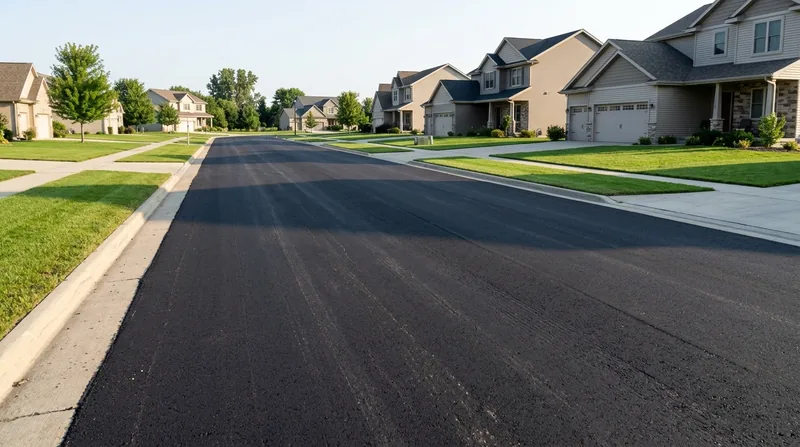




Private Road & HOA Paving in Green Bay serves the subdivisions and master-planned communities across Brown County where winter plow trucks, spring clay saturation, and heavy frost heave demand a base built to last. HOA roads in Howard, Suamico, De Pere, Bellevue, and Ledgeview carry traffic from dozens of homes over terrain that holds water and shifts with the freeze-thaw cycle. We coordinate phased paving across these communities so residents keep access throughout the work, and we size the base for the real load: not just passenger cars, but salt trucks, emergency vehicles, and the deep frost that lifts asphalt off a weak subgrade. Private roads across rural Brown and Kewaunee counties face the same physics, plus the added challenge of long lanes that drain poorly and see seasonal neglect. The difference between a road that lasts eight years and one that lasts fifteen is in the base preparation and the tonnage spec, not in the surface alone.
Why HOA and Private Road Paving Matters in Green Bay
Green Bay's subdivisions were built on clay soil that expands and contracts with moisture and frost. A road that sits on four inches of asphalt over compacted earth will heave and crack within three seasons. Plow trucks in winter add vertical load, and spring thaw turns the clay into a sponge. The cost of ignoring base preparation is a resurfaced road at year five, then another at year nine. We build roads that handle this climate.
- We compact and proof-roll the subgrade to remove soft spots and voids that trap water.
- We install a base course sized for plow truck load and spring saturation, not just passenger traffic.
- We phase work so the HOA board can schedule resident access and coordinate with snow removal contractors.
- We pull permits where the road touches the public right-of-way or changes drainage.
- We verify HOA architectural standards and covenants before we break ground.
The result is a road that carries winter traffic, resists spring heave, and delays the next major work by five to eight years.
Key info: Green Bay municipalities and HOA boards require permits and engineering review for roads that affect drainage or public access. Verify your local requirements with your village building department and your HOA architectural committee before requesting an estimate. Rules vary significantly between Green Bay proper, Ashwaubenon, Howard, Suamico, and Bellevue.
For detailed guidance on permits and regulations, consult your city or village building department.
How We Build HOA Roads That Last: Our Process in Green Bay
Private road and HOA paving is not a one-day job. We survey the existing surface, test the base, identify soft spots, and design a cross-section that sheds water and resists frost heave. Then we execute in phases so your community stays passable. This is the work that separates a road that fails at year six from one that performs at year twelve.
- We visit the site and measure the road, document drainage patterns, and probe the existing base.
- We call Wisconsin 811 for a utility locate before any excavation work begins.
- We remove failed asphalt and diseased or compacted base material, proof-rolling as we go.
- We bring in new base stone, compact it in lifts, and proof-roll to eliminate soft spots.
- We mill and remove any remaining serviceable asphalt if an overlay is the right choice, or we remove it all for full-depth replacement.
- We pave the new surface in one or two lifts, depending on thickness, and open to traffic after initial set.
- We coordinate the schedule with your HOA board so paving happens in phases that maintain resident access.
On a typical Suamico or Howard subdivision road, we work in two or three phases over four to six weeks, closing one section while the next dries and opens.
Real example: A twelve-home cul-de-sac in Ledgeview with alligator cracking and base failure needed full-depth replacement. We phased the work so four homes could access their driveways from the existing road while we removed and rebuilt the rest. The finished road sits on a six-inch base of compacted stone, two inches of asphalt binder, and one inch of wearing course, sized for the frost depth and plow truck load. That road will carry winter traffic for twelve to fifteen years.
For more on how we approach larger paving projects, see our parking lot paving service, which uses the same base-building principles.
Private Road and HOA Paving Approaches
| Approach | Description | Best for |
|---|---|---|
| Full-Depth Replacement | Remove all failed asphalt and base, compact new stone base in lifts, pave new surface in binder and wearing courses. | Roads with base failure, alligator cracking, severe rutting, or poor drainage; roads that have been patched repeatedly. |
| Mill and Overlay | Remove top 1.5 to 2 inches of asphalt, compact the remaining base, and pave new binder and wearing courses. | Roads with sound base but worn or moderately cracked surface; a faster and less expensive option when the subgrade is stable. |
| Chip Seal or Tar and Chip | Seal an existing asphalt surface with a layer of hot tar and stone chips, creating a new wearing surface. | Rural private roads and low-traffic HOA lanes where budget is tight and the existing surface is structurally sound. |
| Recycled Asphalt Millings | Grade and compact recycled asphalt millings as a wearing surface over a stone base. | Rural lanes and private roads where low cost and low speed justify a granular surface; compacts and hardens with traffic and heat. |
| Gravel Base with Grading | Establish proper crown and drainage with compacted stone, raked and graded to shed water. | Long rural lanes and farm access roads where asphalt is not yet justified; a foundation for future paving. |
The right approach depends on the existing surface condition, the base stability, traffic volume, and budget. We assess these factors on site and recommend the option that delivers the best value for the long term.
Private Road & HOA Paving Cost in Green Bay: What to Expect
A private road or HOA street is priced by the square foot of surface, the depth and tonnage of base material, and the complexity of drainage and phasing. A typical HOA road of 2,000 to 3,000 square feet with full-depth replacement runs from $15,000 to $30,000, depending on base condition, frost depth, and whether you choose single or two-lift paving. A mill-and-overlay on a road with a sound base costs 30 to 40 percent less. Rural private lanes with recycled asphalt or chip seal run significantly lower. The single biggest cost driver is base work: if the subgrade is soft or if the existing base is diseased, you will spend more on removal and compaction. If the road drains poorly or sits in clay, the base thickness goes up, and so does the cost.
Get two or three estimates from contractors who will measure the road, probe the base, and give you a written tonnage spec. A vague estimate with no base detail is a red flag. We provide free estimates with measurements and tonnage specifications within 24 hours; call (920) 536-4534 or visit our pricing page for more detail on what moves the cost up or down.
Remember that the cheapest option now is often the most expensive option over time. A road built on a weak base will need resurfacing in five years. A road built right will carry traffic for twelve to fifteen years.
Private Road & HOA Paving Near Me: What Green Bay Homeowners and Boards Should Know
When you hire a contractor for private road or HOA paving, verify their insurance and ask to see a certificate of liability coverage. Ask whether they have experience with HOA coordination and whether they understand the permit requirements in your village or municipality. Request references from completed HOA or private road projects in Green Bay, Ashwaubenon, Howard, or Suamico. Check that the estimate includes a written tonnage spec for the base material, the thickness of each asphalt course, and a timeline for work. Confirm that the contractor will call Wisconsin 811 before any excavation and will help you navigate permits with your local building department and HOA architectural committee.
Beware of contractors who show up unsolicited, offer a price without measuring, or ask for a large cash deposit upfront. Honest estimates are given on site, in writing, with tonnage and thickness specified. Phased work schedules are discussed with the HOA board before paving begins, not after. We work in Green Bay year-round and maintain a local address and local equipment; we are not a traveling crew, and we stand behind our work with a workmanship warranty of one year.
Ready to get started? Contact us for a free, no-obligation estimate on your HOA road or private lane.
Private Road & HOA Paving in Green Bay: Pricing Guide
| Service | Price | Details |
|---|---|---|
| HOA or Private Road, Full-Depth Replacement | Starting at $15,000 | Includes removal of failed asphalt and base, new compacted stone base, and two-course paving; cost scales with square footage and base condition |
| Mill and Overlay on Existing Road | Starting at $9,000 | Milling of top asphalt course, proof-roll of remaining base, and new wearing surface; 30 to 40 percent less than full replacement when base is sound |
| Recycled Asphalt or Chip Seal | Starting at $5,000 | Grading and compaction of recycled millings or tar-and-chip application; budget option for rural lanes and low-traffic roads |
| Phased Scheduling and Coordination | Included | Coordination with HOA board and residents to maintain access throughout multi-phase work; no separate fee |
| Site Estimate with Tonnage Spec | Free | Detailed on-site measurement, base assessment, written tonnage and thickness specification, response within 24 hours |
Indicative pricing, the exact cost depends on square footage, finish, and site access. Free personalized estimate within 24h at (920) 536-4534.


